
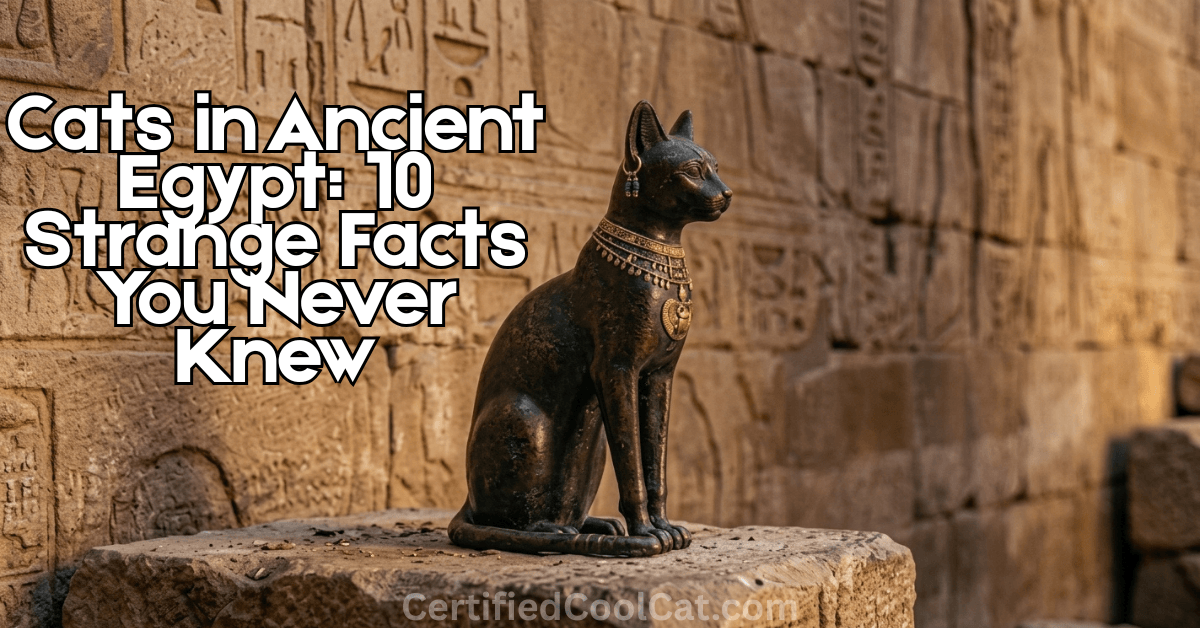
Cats in ancient Egypt had a pretty good reputation. They caught pests, lived alongside families, appeared in tomb art, and became linked with some of Egypt’s most powerful gods. Thousands were even mummified and buried as religious offerings.
But there’s a catch.
You’ve probably heard that ancient Egyptians worshipped cats as gods. That’s one of those history facts that gets repeated so often that nobody stops to ask if it’s actually true.
The real story is much more interesting.
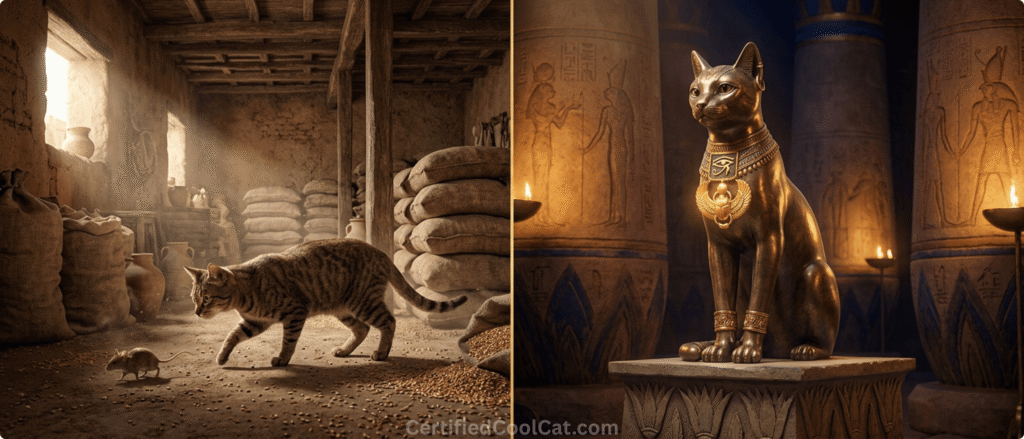
Ancient Egyptians valued cats for practical reasons before felines became powerful religious symbols. Their ability to switch from gentle companion to skilled hunter also made them a natural fit for Egyptian ideas about protection and divine power.
And yes, there are cat mummies. Lots of them.
Here are 10 strange facts about Egyptian cats that show just how unusual this relationship became.
1. Ancient Egyptians Didn’t Actually Worship Their Pet Cats
Let’s clear up the biggest myth first. Ancient Egyptians did not simply believe every cat walking around the neighborhood was a god. Cats were closely connected with certain Egyptian deities. That made them religiously important, but it didn’t mean someone’s pet cat was automatically worshipped as a divine being.
The distinction matters.
Egyptian religion often linked animals with characteristics of particular gods. A falcon, crocodile, jackal, lioness, or cat could represent qualities associated with divine power. Cats were especially interesting because they seemed to have two personalities.
Anyone who owns a cat probably knows where I’m going with this.
One minute, you’ve got a peaceful animal curled up beside you. The next minute, something moves and you’ve got a tiny predator on your hands. Ancient Egyptians noticed that contrast too.
The Smithsonian describes cats as both nurturing and protective yet capable of being fierce and aggressive. Those opposing traits helped connect felines with Egyptian gods and rulers.
What Cats Meant to Ancient Egyptians
So, what cats meant to ancient Egyptians can’t be summed up with one word like “sacred.”
Cats could represent:
- Protection
- Motherhood
- Fertility
- Strength
- Hunting ability
- Divine power
Their real-world usefulness mattered too. Cats could protect homes and food supplies from mice and other pests. They could also kill snakes.
That combination of household protector and dangerous hunter gave cats a special place in Egyptian life.
It also helps explain why ancient Egyptians worshipped cats without assuming that Egyptians literally bowed down to every house cat they saw.
2. Cats Had a Job Long Before They Became Sacred Symbols
Before cats were immortalized in bronze statues, they had a more practical job.
Pest control.
Ancient Egypt depended heavily on agriculture. Grain was valuable, and storing it attracted animals that were quite happy to help themselves.Mice and rats could damage food supplies. Snakes and other unwanted animals could also enter areas where people lived and worked.
Cats offered a natural solution.
Their hunting ability made them useful around homes, farms, and food stores. So, cats were valued because they helped keep homes and granaries free of mice, rats, and snakes.
Egyptian Cats Weren’t Just Lazy House Pets
Over time, cats became more than pest hunters. They began appearing in Egyptian art close to people. Tomb scenes show cats beneath their owners’ chairs and accompanying people during hunting trips in the Nile marshes.
The Metropolitan Museum of Art also notes that by New Kingdom times, cats had become household companions and frequently appeared with their owners in tomb scenes. That gives us an important clue.
The cat’s place in Egyptian culture wasn’t based entirely on religion. Cats had practical value and could share people’s everyday lives. In other words, the ancient Egyptian cat may have earned its dinner before claiming the best seat in the house. Some things haven’t changed much.
3. Bastet Wasn’t Always the Cute Cat Goddess We Picture Today
If you’ve read anything about Egyptian cats, you’ve probably encountered Bastet. She’s often called the Egyptian cat goddess. That’s accurate enough for a quick description, but there’s much more to her story.
Bastet was a powerful protective goddess associated with Lower Egypt. Her character and appearance changed over Egypt’s long history. She could have lioness characteristics, especially in earlier forms. Later, she became strongly associated with the domestic cat and could appear as a cat or cat-headed woman.
Her gentler feline form was connected with protection, motherhood, fertility, and prosperity. Her main cult center was Bubastis, located in the Nile Delta. Thousands of cat mummies and many cat statues have been discovered there.
Bastet Wasn’t Ancient Egypt’s Only Feline Deity
When looking at ancient Egypt feline deities, Bastet gets most of the attention.
But she wasn’t alone.
Sekhmet was commonly depicted as a lioness-headed woman. She represented a much fiercer form of power and could be linked with destruction as well as protection.
There’s also Mafdet, an early Egyptian deity associated with protection against dangerous creatures. Her exact feline identity isn’t always clear, but she was represented with feline characteristics.
These gods help us understand why cats and other felines were so meaningful. Egyptians weren’t fascinated with felines just because they looked elegant. They saw characteristics in them that could represent different forms of divine power.
4. Cats Symbolized Two Completely Different Personalities
This may be my favorite part of feline symbolism in ancient Egypt because modern cat owners can still recognize it.
Cats are contradictions. A mother cat can be remarkably gentle with her kittens. She cleans them, feeds them, protects them, and keeps them close.
Threaten those kittens and you’ll meet a very different animal. Ancient Egyptians could associate these opposite traits with divine forces.
The Gentle Side of the Cat
The calmer side of feline behavior could represent:
- Motherhood
- Fertility
- Protection
- Nurturing
- Household safety
These qualities fit particularly well with Bastet.
The Dangerous Side of the Cat
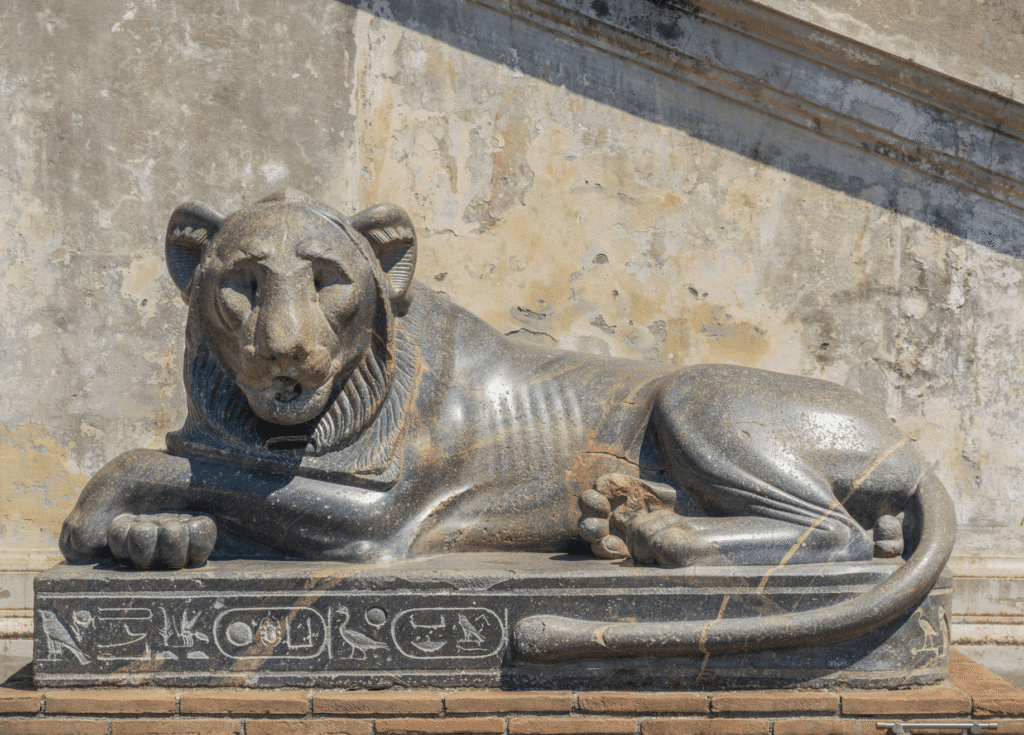
Then there’s the hunter. Cats are fast, alert, territorial, and equipped with claws and teeth. Larger felines such as lionesses made this dangerous side even clearer.
Sekhmet represented some of that fierce power, while Bastet became associated with its gentler and more protective side.
The Metropolitan Museum of Art describes Bastet and Sekhmet as different aspects of divine power. Sekhmet represented dangerous forces, while Bastet represented a more benevolent form that could be approached through ritual.
That’s a much richer explanation than simply saying, “Egyptians liked cats.”
5. Ancient Egyptians Mummified Huge Numbers of Cats
Now things start getting strange. When we think about Egyptian mummies, we usually picture pharaohs wrapped in linen and placed inside decorated coffins. Humans weren’t the only ones being mummified. Cats were too surprisingly.
Large numbers of cat mummies have been discovered at Egyptian religious sites. Major catacombs existed at places including Bubastis and Saqqara.
Some cats were carefully wrapped in linen. Cat-shaped containers and coffins were also produced. The Metropolitan Museum of Art has examples of boxes that once held small animal mummies and bronze cat figures associated with these offerings.
Why Were Cats Mummified?
This is where we need to separate another popular assumption from the evidence. A mummified cat wasn’t necessarily someone’s beloved pet. Many were religious offerings.
A worshipper could dedicate an animal mummy to a deity as an act of devotion. Cats became especially important as offerings connected with Bastet. Some cat statues were deposited in the same catacombs as mummified cats. There were even hollow bronze figures capable of holding a cat mummy inside.
So when archaeologists discover ancient Egyptian cat mummies, they aren’t simply finding an ancient version of a modern pet cemetery. They’re uncovering part of a much larger religious practice.
6. Some Cats Were Raised Specifically for Religious Offerings
This is the darker part of the story. The huge demand for animal mummies meant that some cats were bred specifically for religious use. The British Museum notes that cats were bred in large numbers in parts of Egypt so worshippers of Bastet could pay for their ceremonial burial.
The Smithsonian also reports that Egyptians bred and sacrificed cats to the gods before mummifying and burying them. That can be uncomfortable for modern cat parents to swallow. But it’s important not to judge an ancient religious practice only through today’s idea of pet ownership.
Cat Mummies Became Part of a Religious Economy
Think about everything required to support this practice:
- Someone had to raise the animals.
- Someone prepared the remains.
- Someone supplied linen and containers.
- Craftsmen produced cat statues, coffins, and religious objects.
- Worshippers obtained these items and dedicated them to the gods.
Cat mummification therefore sat at the meeting point of religion, craftsmanship, animal keeping, and trade. The cat had come a very long way from simply catching mice near a grain store.
7. Ancient Writers Claimed Killing a Cat Could Have Deadly Consequences
You might have encountered some version of this claim online:
Kill a cat in ancient Egypt and you would be sentenced to death.
The truth needs a little more care. Ancient writers did describe severe reactions to harming certain animals. Herodotus wrote about penalties connected with killing sacred animals. Another Greek historian, Diodorus Siculus, later told a dramatic story involving a Roman who killed a cat and faced an enraged crowd.
Was Killing a Cat Really Punishable by Death?
I wouldn’t turn those accounts into a simple rule that applied to every Egyptian, cat, and period. Ancient Egypt existed for thousands of years. Laws, beliefs, rulers, and religious customs changed.
There’s another problem with this claim. Herodotus and Diodorus were Greek writers describing Egypt for outside audiences. Their accounts are valuable historical sources, but that doesn’t mean every dramatic story should be treated like a surviving Egyptian law book.
What these accounts do show is that Egyptians’ attitudes toward certain animals were remarkable enough to catch the attention of foreign visitors. Cats clearly mattered. But “kill a cat and automatically receive the death penalty” is too simple.
8. Egyptians Were Said to Shave Their Eyebrows When a Cat Died
Imagine explaining this one to your coworkers.
“Why don’t you have eyebrows?”
“My cat died.”
That’s essentially the mourning custom described by the Greek historian Herodotus. He wrote that when a household cat died naturally, the people living in the home shaved their eyebrows. It’s one of the strangest stories connected with cats in ancient Egypt.
But there’s an important detail here left out.
Did Egyptians Really Mourn Pet Cats This Way?
Herodotus is our source for the eyebrow-shaving story. That means I wouldn’t present it as a proven custom followed by every Egyptian family. It’s better described as something an ancient writer reported about Egyptian mourning.
There is stronger evidence that cats could share close spaces with people. Egyptian artwork depicts cats beside their owners, beneath chairs, and participating in hunting scenes. That doesn’t prove every Egyptian treated a cat exactly like we treat pets today.
I mean, does everybody like cats today? Nope. And I’ll bet things were no different then.
It does show that the relationship went well beyond pest control.
9. Ancient Egyptians Had a Hieroglyph for Cats
Here’s one for the language lovers.
The ancient Egyptian word for cat is commonly transliterated as miw or mjw, although you’ll see variations because Egyptian words are being represented using modern alphabets.
You’ll also sometimes see mau used in popular writing.
And yes, people have noticed how wonderfully cat-like miw sounds.
Meow.
It’s tempting to imagine an ancient Egyptian pointing at a cat and simply naming it after the noise it made. The possible sound connection is fun, but we should be careful about presenting modern pronunciation guesses as absolute fact.
What Did the Egyptian Cat Hieroglyph Look Like?
When researching cats in Egyptian hieroglyphs, it’s important to understand that hieroglyphs weren’t simply little pictures with one symbolic meaning. The writing system could use signs to represent sounds, words, and ideas.
A recognizable cat could appear as a hieroglyphic sign, but that doesn’t mean every picture of a cat translates into something mystical. Sometimes a cat is, well, a cat.
Cats Also Appeared in Egyptian Tomb Art
Egyptian art gives us another window into daily life.
Cats appear:
- Sitting beneath chairs
- Near their owners
- In household settings
- Accompanying people during marsh hunts
These images help historians understand how cats fit into Egyptian society. They weren’t restricted to temples. They could be part of the home.
10. Egyptian Cat Statues Weren’t Just Ancient Decorations
You’ve probably seen one.
A sleek black or bronze Egyptian cat sits perfectly upright. Its ears point upward, its chest is tall, and its tail wraps neatly beside its body. It looks like something designed specifically for a modern cat lover’s bookshelf.
But many ancient examples had a religious purpose.
Cat statuettes could be dedicated at temples or deposited in catacombs alongside mummified cats. Some were decorated with earrings, necklaces, scarabs, or protective symbols such as the wedjat, better known as the Eye of Horus.
Meet the Famous Gayer-Anderson Cat
One of the best examples is the Gayer-Anderson Cat at the British Museum. This bronze figure dates to around 600 BCE and depicts a form of Bastet. It has gold earrings and a nose ring. A silver protective pectoral appears on its chest, including a wedjat eye.
The result is both beautiful and imposing. This wasn’t someone putting a fancy collar on Fluffy. The jewelry and symbols had religious meaning.
If you’d like to see it yourself, the British Museum’s Gayer-Anderson Cat page includes photographs, background information, and a 3D model of the statue.
Where Can You See Ancient Egyptian Cats Today?
If you’re searching for the best places to see Egyptian cats, what you’re probably looking for are surviving Egyptian cat artifacts.
The British Museum in London is an obvious choice because of the Gayer-Anderson Cat.
The Metropolitan Museum of Art in New York also has an excellent collection of Egyptian cat figures, Bastet objects, and artifacts associated with cat mummies.
You don’t even have to travel to start exploring them. Both museums make information about many objects available online.
So, Why Were Cats in Ancient Egypt So Important?
There wasn’t one reason. That’s probably the biggest lesson from these 10 facts. The cats in ancient Egypt occupied several roles at the same time. They were hunters that could control pests. Some became household companions.
Their contrasting personalities made them powerful symbols of protection, motherhood, aggression, and divine strength. They became closely associated with Bastet and other feline deities. Cats also became part of a huge system of religious offerings, resulting in thousands of mummified animals and countless cat-shaped objects.
That’s very different from the simple claim that “Egyptians worshipped cats.“
The truth is more complicated—and much more interesting.
Frequently Asked Questions About Cats in Ancient Egypt
Why Were Cats So Important in Ancient Egypt?
Cats were useful hunters that helped control mice, rats, snakes, and other pests. They also became household companions and were associated with religious ideas about protection, motherhood, fertility, and divine power.
Did Ancient Egyptians Worship Cats?
Not exactly.
Egyptians associated cats with deities, especially Bastet. Cats could be considered sacred to a deity without every individual cat being worshipped as a god.
That’s why the popular idea that ancient Egyptians simply worshipped cats needs more explanation.
What Did Cats Symbolize in Ancient Egypt?
Cats could symbolize protection, motherhood, fertility, nurturing, strength, and aggression.
Their ability to be both gentle and fierce helped make them powerful religious symbols.
What Was the Egyptian Cat Goddess Called?
The Egyptian goddess most strongly associated with domestic cats was Bastet.
She was connected with protection, motherhood, fertility, and prosperity. Her major cult center was at Bubastis.
What Did Ancient Egyptians Call Cats?
The Egyptian word for cat is commonly transliterated as miw or mjw. Different spellings appear because scholars are representing an ancient language using modern writing systems.
Were Cats Mummified in Ancient Egypt?
Yes.
Large numbers of cats were mummified. Many were religious offerings associated with Bastet rather than beloved household pets receiving a modern-style pet burial.
Cat mummies and related objects have been discovered in large catacombs at sites such as Bubastis and Saqqara.
Did Egyptians Really Shave Their Eyebrows When a Cat Died?
The ancient Greek historian Herodotus claimed that household members shaved their eyebrows after a cat died naturally.
It’s a fascinating story, but it should be described as Herodotus’ account rather than a proven custom followed by every ancient Egyptian.
Were Cats Considered Sacred in Ancient Egypt?
Cats had sacred associations, especially through Bastet.
But “sacred” doesn’t mean Egyptians believed every individual cat was literally a god. Felines could represent divine qualities and serve important roles in religious practice.
Final Thoughts: Cats in Ancient Egypt Were More Than Sacred Pets
The history of cats in ancient Egypt becomes much more fascinating once we get past the idea that Egyptians simply worshipped them.
Cats started with a practical advantage. They were excellent hunters living in a society where protecting food from pests mattered.
Then something bigger happened.
Their strange mix of gentleness and ferocity gave Egyptians an animal that could represent protection, motherhood, danger, and divine power all at once.
Cats entered homes, tomb paintings, temples, religious offerings, hieroglyphic writing, bronze statues, and vast animal catacombs.
Thousands of years later, we’re still fascinated by them.
And perhaps that’s the least surprising fact on this list.
After all, modern cats may no longer have temples dedicated to them—but try telling one that.









I’ve been searching the web a lot for ideas that we thought were held by ancients, and I came across your post. I’ve always heard that ancient Egyptians worshipped cats, so I found the distinction between worshipping cats themselves and associating them with particular gods especially interesting.
What really surprised me, though, was the darker side of cat mummification. I had assumed mummified cats were probably beloved pets whose owners wanted to preserve them, much like human mummies. I never realized cats were actually bred in large numbers specifically to become religious offerings. That certainly changes the picture of how cats fit into Egyptian religious life.
I was also fascinated by how much the Egyptians recognized the two very different sides of a cat—the gentle household companion and the fierce little hunter. Cat owners can certainly recognize that combination today! Do you think our modern relationship with cats has more in common with the ancient Egyptians’ relationship with them than we might realize?
Thanks for such a thoughtful comment! I had a similar reaction when learning more about cat mummification. It’s easy to picture every mummified cat as a treasured family pet, but the reality was much more complex.
And yes, I do think our relationship with cats today has quite a bit in common with the ancient Egyptians. We may not connect cats with gods like Bastet, but we still admire many of the same qualities they did. Cats can be affectionate companions one minute and remarkably skilled little hunters the next.
I also find it interesting that cats seem to have maintained a certain independence throughout their relationship with humans. We care for them, give them comfortable homes, and occasionally rearrange our lives around them—yet somehow they still manage to act like they’re the ones in charge!
Thanks again for reading and sharing your thoughts. You brought up a great point about just how much of that ancient human-cat relationship still feels familiar today.