
Did Ancient Egyptians worship cats, or is that one of those history facts that got stretched over time? We’ve all heard some version of the story. Ancient Egyptians loved cats so much that they treated them like gods.
The truth is a little more complicated.
Ancient Egyptians certainly had a special relationship with cats. Cats protected homes, appeared in artwork, and became linked with powerful gods. Thousands were even mummified. But that doesn’t mean Egyptians bowed down every time a tabby walked past.
Let’s separate what we know from what has become a popular myth.
Did Ancient Egyptians Worship Cats?
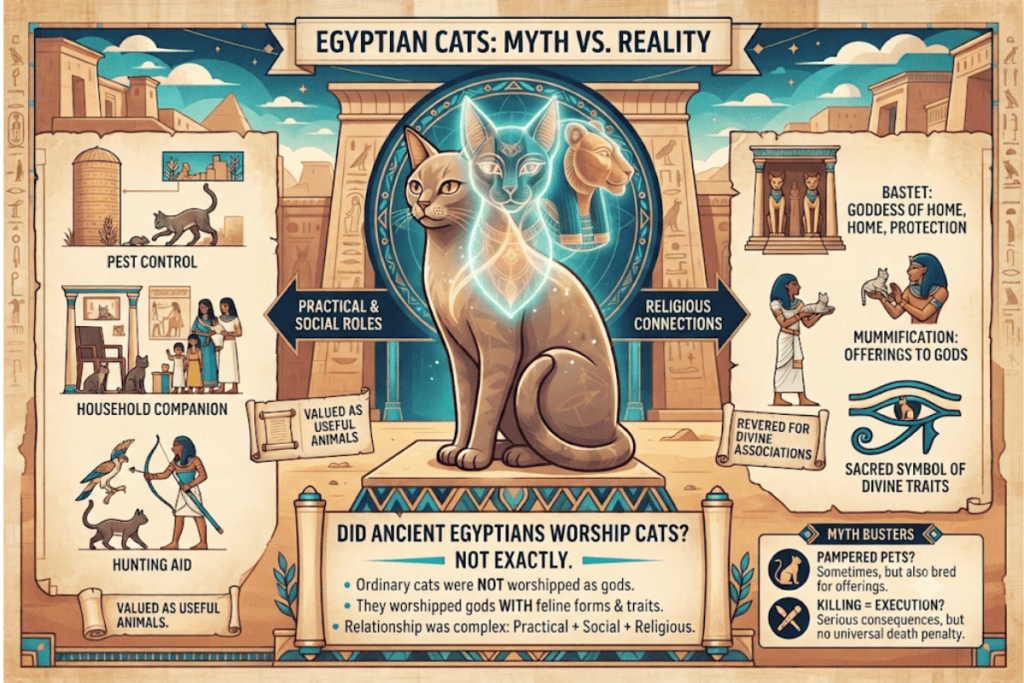
The short answer is not exactly.
Ancient Egyptians did not generally worship ordinary household cats as gods. Instead, they worshipped gods who could appear as animals or share traits with them. Several Egyptian gods had feline connections. That distinction matters.
A household cat could have religious meaning without being considered a god itself. Egyptians saw traits in animals that reminded them of the powers held by their gods. Cats were skilled hunters. They were protective mothers. They could be gentle one minute and surprisingly fierce the next.
Anyone who has tried putting an unwilling cat into a carrier knows that last part still holds true.
Why Do We Think Egyptians Worshipped Cats?
It’s easy to see where the idea came from. Cats appear throughout ancient Egyptian art. Some gods were shown with feline heads. Archaeologists have also discovered huge numbers of mummified cats. Put those facts together, and saying “Egyptians worshipped cats” sounds reasonable.
The problem is that it leaves out much of the story. Cats had practical, social, and religious roles. Those roles sometimes overlapped, but they weren’t all the same thing.
Why Were Cats So Important in Ancient Egypt?
Before cats became famous for their religious connections, they were useful animals to have around. Ancient Egypt depended heavily on agriculture. Grain and other foods needed to be grown, harvested, and stored. That stored food attracted pests.
Cats Had a Practical Job
Mice and rats could eat stored grain and contaminate food supplies. Cats were natural hunters that helped keep rodent numbers down. They could also kill or scare away snakes and other unwanted animals.
You didn’t need to believe a cat was divine to appreciate having one nearby. A good mouser was valuable. Over time, the cat’s hunting skill and protective nature helped give the animal a special place within Egyptian culture.
Cats Became Part of Egyptian Households
Ancient Egyptian artwork gives us fascinating glimpses into how closely cats lived with people. Cats sometimes appear sitting beneath chairs in tomb paintings. Other scenes show them accompanying people while hunting birds.
Some images even show cats wearing collars. These scenes suggest that cats could have close relationships with humans. Still, we should be careful about viewing those relationships exactly as we view pet ownership today.
An Egyptian family wasn’t necessarily buying Fluffy a birthday present every year.Their cats could be companions while still serving practical purposes around the home.
Cats had already been living alongside humans anyways for thousands of years before they became important in ancient Egypt. The full story of how cats became domesticated began much earlier in the Near East.
Were Cats Sacred in Ancient Egypt?
This is where the story gets more interesting. Cats could be considered sacred because of their connections with Egyptian religion. However, “sacred” doesn’t mean every cat was treated as a god.
Ancient Egyptians often connected animals with certain divine qualities. A lion could represent strength and danger. A falcon might represent power and the sky. Cats could represent protection, motherhood, fertility, and controlled aggression.
Bastet: The Goddess Most Associated With Cats
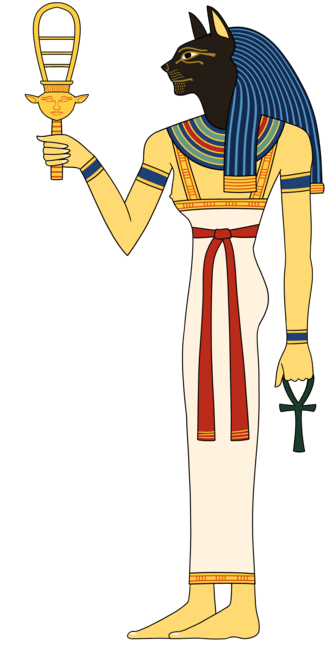
No discussion of Egyptian cats is complete without Bastet. That’s her to the right.
Bastet became one of the Egyptian gods most closely connected with domestic cats. She was associated with the home, women, childbirth, protection, and other parts of daily life.
Interestingly, Bastet wasn’t always represented as the friendly-looking cat goddess we often picture today. Earlier representations gave her the form or head of a lioness. Over time, her image became more closely tied to domestic cats.
Her major religious center was at Bubastis in the Nile Delta. People worshipped Bastet. That doesn’t mean they believed the cat sleeping beside the grain basket was literally Bastet.
For more background on the goddess and her changing role, the Encyclopaedia Britannica overview of Bastet provides a useful introduction.
Sekhmet and Other Feline Deities
Bastet wasn’t the only Egyptian god with feline characteristics.
Sekhmet was commonly shown as a woman with the head of a lioness. She was associated with war and destruction, but also with healing. That’s quite a combination.
It also shows why feline imagery worked so well in Egyptian religion. Cats and their larger relatives could represent very different qualities. They could nurture and protect, yet they could also be dangerous hunters.
How Did Ancient Egyptians Treat Their Cats?
We don’t have ancient Egyptian pet blogs telling us what people named their cats or how often they scratched the furniture. Instead, historians rely on artwork, written records, archaeology, and burial evidence.
What Egyptian Art Tells Us
Cats appear in several Egyptian tomb scenes. One well-known type of image shows a cat sitting beneath a person’s chair. Other images place cats near food, family members, or hunting scenes.
These images suggest cats had a recognized place in human households. They don’t prove that every Egyptian owned a cat or treated one as a modern family pet.
Ancient art could carry symbolic meanings as well as show parts of everyday life.
Why Did Ancient Egyptians Mummify Cats?
Cat mummies are probably one of the biggest reasons the Egyptian cat-worship story refuses to disappear. Archaeologists have found enormous numbers of mummified cats at Egyptian sites. At first glance, that sounds like evidence of extreme devotion to beloved pets.
The reality is much stranger.
Cat Mummies Were Often Religious Offerings
Some cats may have been buried because their owners cared about them. Many others were mummified as religious offerings. People could purchase or dedicate an animal mummy connected with a particular god. Cats were strongly associated with Bastet, making cat mummies suitable offerings.
This created demand for large numbers of animals.
The Cat Mummy Industry
Evidence suggests cats were bred in large numbers for use as religious offerings. That creates an uncomfortable contrast with the popular claim that every Egyptian cat was protected and pampered.
A cat could be respected as an animal associated with a god while also being raised specifically for a religious ritual. Ancient Egyptian beliefs about animals simply don’t fit neatly into our modern ideas about pets.
Did Egyptians Mourn Their Pet Cats?
One of the strangest stories about Egyptian cats comes from the Greek historian Herodotus. He wrote that when a household cat died, members of the family shaved their eyebrows as a sign of mourning. It’s a memorable image. It’s also one we should treat with some caution.
The Famous Eyebrow-Shaving Story
Herodotus visited Egypt during the fifth century B.C. and recorded many observations about Egyptian life. However, he was a Greek visitor writing about another culture. Historians don’t accept every detail in his writings without question.
His account suggests that some Egyptians deeply mourned cats.
It doesn’t necessarily prove that every Egyptian family shaved its eyebrows whenever a cat died. This seems far fetched to me, do you agree?
Could You Be Punished for Killing a Cat?
You’ve probably encountered another dramatic claim online: killing a cat in ancient Egypt was punishable by death. There are ancient accounts describing serious consequences for harming cats. Later writers even tell stories of people reacting violently when cats were killed.
However, saying there was a universal Egyptian law that automatically sentenced anyone who killed a cat to death goes beyond the evidence we have. This is a good example of how a small piece of history can turn into a much bigger internet “fact.”
Egyptians clearly placed great importance on certain animals. The exact legal consequences for harming them aren’t always as clear as modern retellings suggest.
What Modern Culture Gets Wrong About Egyptian Cats
The real story of cats in ancient Egypt is more interesting than the myths. Here are some you may have heard and some you haven’t.
Myth: Egyptians Worshipped Every Cat
Fact: Egyptians worshipped gods associated with feline forms and characteristics. Ordinary cats weren’t simply treated as gods walking around on four paws.
Myth: Every Egyptian Cat Was a Pampered Pet
Fact: Cats could be companions, hunters, religious symbols, and ritual animals. Feel sorry for the latter for sure.
Myth: All Cat Mummies Were Beloved Pets
Fact: Many mummified cats were created as religious offerings.
Myth: Killing a Cat Always Meant Execution
Fact: Ancient sources show that cats could receive strong protection. Evidence for an automatic nationwide death penalty is much less certain. I’ll say the instant death sentence probably wasn’t a thing. It also might have depended on whose cat it was.
So, Did Ancient Egyptians Worship Cats?
So, did Ancient Egyptians worship cats?
Not in the simple way suggested. They valued cats for their ability to hunt pests and protect food. Cats lived closely with people and appeared frequently in Egyptian artwork.
Feline traits also became connected with powerful gods, especially Bastet and Sekhmet.
Some cats were mummified. Others were used as religious offerings. Some may have been loved household companions. That makes the relationship between cats and ancient Egyptians far more complex than simply saying they worshipped them.
Cats lived at an unusual meeting point between daily life and religion. Of course, try explaining that distinction to your cat.
I’m sure he’d prefer the worship version.😹😹😹
Frequently Asked Questions About Ancient Egyptian Cats
Did Ancient Egyptians Think Cats Were Gods?
Generally, no. Egyptians worshipped gods that could have feline forms or characteristics. That didn’t make every ordinary cat a god.
Why Were Cats Sacred in Ancient Egypt?
Cats were associated with protection, hunting, motherhood, and several Egyptian gods. Their ability to control rodents also made them useful around homes and food stores.
Hey, this website sometimes features affiliate links of which I may make a commission-at no extra cost to you. I may recommend products sometimes, but they are products I trust whole-heartedly. As an Amazon associate, I earn from qualified purchases
Want to immortalize Fluffy? Then try getting their portrait made with a custom pet portrait from Nexbie and maybe their painting will be rediscovered thousands of years from now in true Egyptian-fashion!
Which Egyptian God Was Associated With Cats?
Bastet became the Egyptian goddess most closely associated with domestic cats. Earlier forms of Bastet were more closely connected with lioness imagery.
What Happened If Someone Killed a Cat in Ancient Egypt?
Ancient sources suggest harming cats could be taken very seriously. However, the popular claim that killing any cat automatically resulted in execution isn’t firmly supported as a universal law.
Why Did Egyptians Mummify Cats?
Many cats were mummified as religious offerings connected with feline gods such as Bastet. Not every cat mummy represents a beloved household pet.
Did Ancient Egyptians Keep Cats as Pets?
Evidence suggests cats lived closely with humans and sometimes formed close bonds with them. However, their role could include companionship, hunting, pest control, and religious purposes.
So, Did Ancient Egyptians Worship Cats?
So, did ancient Egyptians worship cats? Not quite—at least not in the way the popular myth suggests.
Ancient Egyptians deeply respected cats and valued them for their ability to protect homes, food stores, and families. Cats also became closely linked with gods such as Bastet. But Egyptians weren’t usually bowing down and worshipping their household cats as gods.
The truth is more interesting. Cats lived at the crossroads of everyday life, religion, protection, and symbolism. Their connection with the divine gave them a special status that few other animals enjoyed.
Thousands of years later, cats may no longer guard Egyptian grain stores or represent powerful goddesses. Yet they still have an impressive ability to take over our homes, claim the best seat, and convince us that everything belongs to them.
Maybe some things haven’t changed that much after all.