
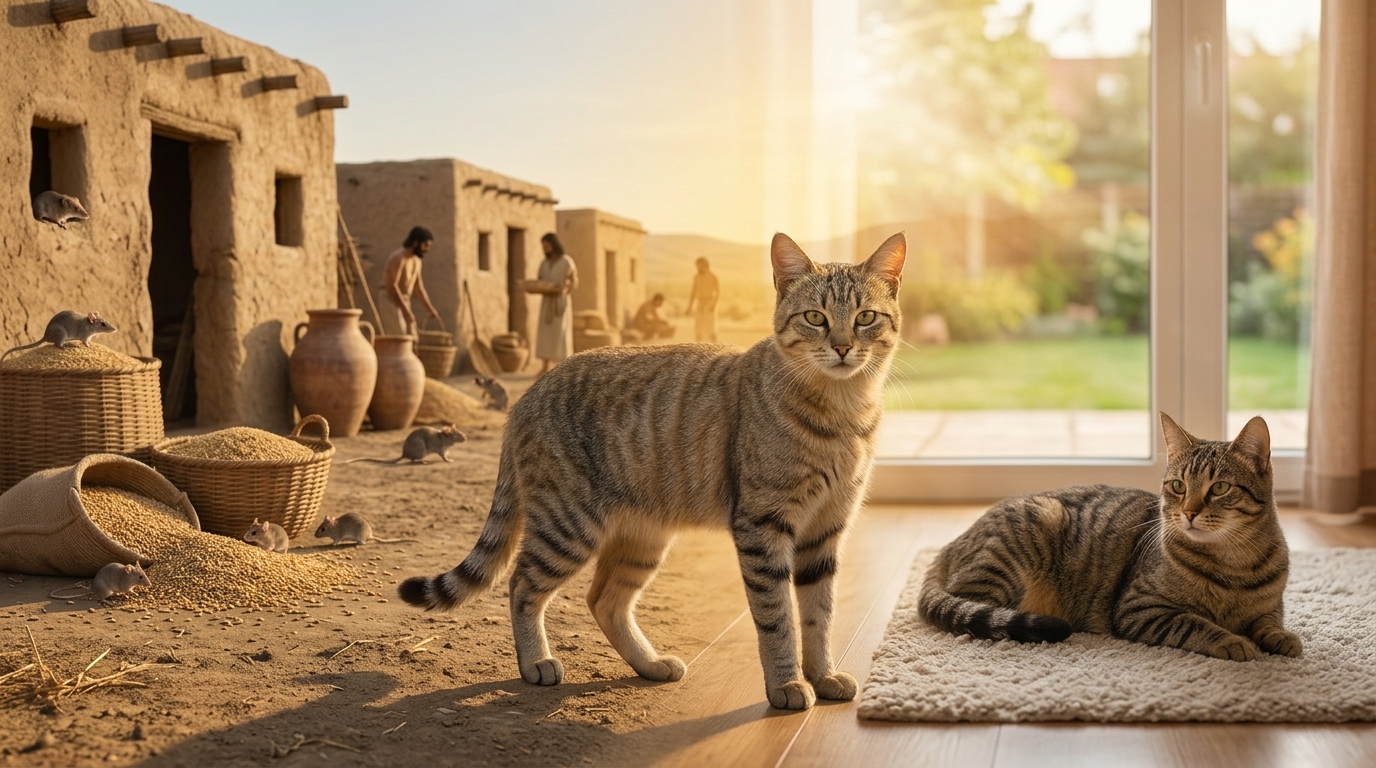
How did cats become domesticated? Unlike dogs, cats weren’t simply captured and bred by humans for specific jobs. Their story appears to have started thousands of years ago when wildcats discovered something hard to resist around early farming villages: mice.
As people began growing crops and storing grain, rodents followed. Wildcats followed the rodents. Humans got free pest control. Wildcats got an easy hunting ground. It was a pretty good deal for everyone involved.
Over thousands of years, this simple relationship helped turn wild hunters into the house cats now sleeping on our couches.
But the story wasn’t quite as simple as humans deciding they wanted cats as pets.
Where Did Domestic Cats Come From?
Today’s domestic cats trace much of their ancestry to the African and Near Eastern wildcat, Felis silvestris lybica. These small wildcats still live across parts of Africa and the Middle East. They look surprisingly similar to some domestic cats. They have slender bodies, long legs, striped coats, and excellent hunting skills.
Genetic research has helped scientists trace domestic cat ancestry back to wildcat populations living around the Near East. A 2022 genetic study of more than 1,000 random-bred cats supported the Fertile Crescent and eastern Mediterranean region as the main cradle of cat domestication.
That’s quite different from dogs. Thousands of years of selective breeding produced dogs ranging from tiny Chihuahuas to massive Great Danes.
Cats stayed much closer to their original wildcat body plan.
Your tabby may spend most of the afternoon asleep in a sunny window, but there’s still plenty of wildcat under all that fluff.
How Did Cats Become Domesticated?
The first big step toward cat domestication probably came with farming. Roughly 10,000 years ago, people in the Fertile Crescent began establishing farming communities. This region included parts of what are now Turkey, Syria, Iraq, Israel, Jordan, and nearby areas.
Farming created a new problem. People had to store grain. And wherever humans store food, rodents have an annoying habit of showing up for dinner. Mice were attracted to grain stores and other food around settlements. Wildcats were attracted to the mice.
Humans soon had some very effective pest control hanging around their villages. It wasn’t as if someone grabbed a wildcat, put a collar on it, and declared it domesticated. The process happened slowly.
Wildcats that were less afraid of humans could hunt near settlements without running away. Those cats had access to a steady supply of prey. Humans also benefited because the cats helped control animals that could damage stored food.
Over many generations, cats that tolerated people had an advantage around human settlements. That helped create a closer relationship between the two species.
Did Cats Domesticate Themselves?
You might have heard some say that cats “domesticated themselves.” Well, I’d say there’s some truth behind that idea, although it’s an oversimplification.
Humans actively selected many domestic animals for certain jobs. Dogs were bred for hunting, guarding, herding, and other tasks. Livestock were bred for meat, milk, wool, strength, and temperament.
Early cats didn’t require much help. They were already excellent mouse hunters. Humans didn’t need to teach them how to catch rodents or carefully control their breeding to make them useful.
Instead, wildcats that could tolerate living near humans gained access to food. Humans gained protection from pests. Scientists sometimes describe this as a commensal pathway to domestication. In simple terms, cats were first attracted to the environment humans created rather than being deliberately captured and bred.
It was only later that people began breeding cats heavily for coat colors, patterns, appearance, and personality.
Ancient DNA research published in Nature Ecology & Evolution found that a coat-color variant associated with blotched tabby patterns didn’t become common until after the Middle Ages. That supports the idea that humans began selecting cats for appearance much later than many other domestic animals.
The 9,500-Year-Old Cat That Changed the Story
One of the best clues about early cat domestication comes from Cyprus. Archaeologists discovered the remains of a human buried near a cat at a Neolithic site called Shillourokambos.
The burial dates back about 9,500 years. That alone is interesting, but there’s an even more important detail. Wildcats weren’t native to Cyprus. Someone had to bring cats to the island from the mainland, most likely by boat.
That suggests people valued cats enough to deliberately transport them thousands of years before the famous cat culture of ancient Egypt. The discovery helped change how researchers viewed the history of cat domestication.
Egypt may have played a huge role in the story, but it wasn’t where the relationship began.
A Quick Cat Domestication Timeline
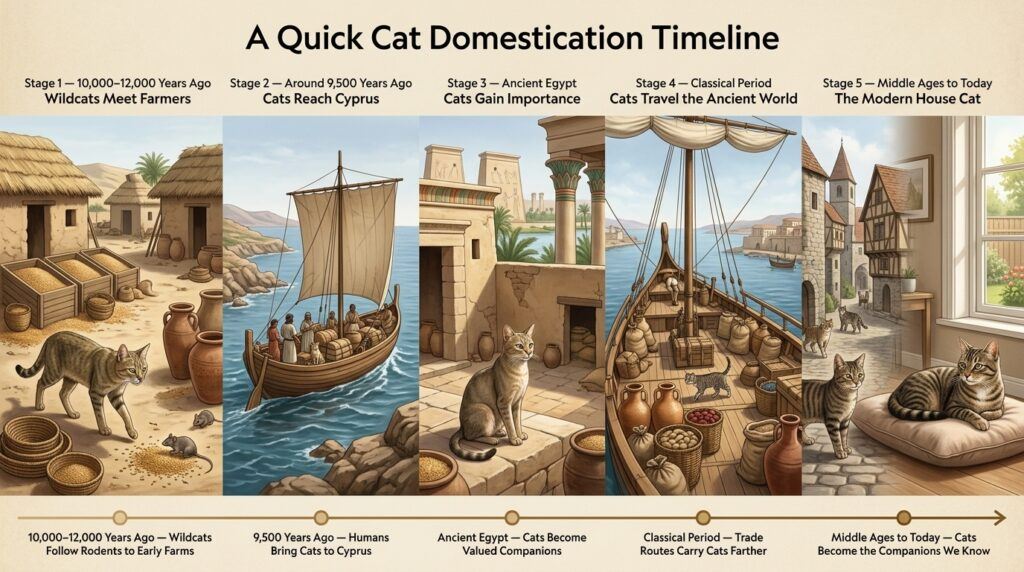
Here’s the basic story as researchers understand it today.
Around 10,000–12,000 years ago:
Farming communities develop in the Fertile Crescent. Grain stores attract rodents, which attract wildcats.
Around 9,500 years ago:
A human and cat are buried near each other in Cyprus. Since wildcats weren’t native to the island, people must have transported cats there.
Thousands of years later:
Cats become increasingly important in Egypt as hunters, household animals, and animals connected with religious beliefs.
Classical period:
Cats with Egyptian ancestry spread farther through the ancient world along land and sea trade routes.
Middle Ages and later:
Humans begin selecting cats more heavily for visible traits such as coat patterns.
Modern era:
Selective breeding eventually produces the many recognized cat breeds we know today.
Ancient Egypt’s Important Role in Cat History
Ancient Egyptians didn’t start the original relationship between humans and cats, but they certainly took it to another level. Cats became valued household animals and appeared frequently in Egyptian art. Their ability to catch mice and other pests made them useful. Over time, cats also became connected with Egyptian religious beliefs.
One of the best-known examples is Bastet. Bastet was an Egyptian goddess associated at different points with protection, domestic life, fertility, motherhood, and feline imagery.
This is where a common misconception enters the story.
Did Ancient Egyptians Worship Cats?
Ancient Egyptians revered several gods and goddesses associated with animals, but that doesn’t mean ordinary house cats were simply worshipped as gods. Cats could be considered sacred animals connected with certain deities. They were also mummified and sometimes offered in religious settings.
For example, the Metropolitan Museum of Art describes mummified cats being buried within temple areas during rituals honoring Bastet.
That’s different from saying Egyptians believed every household cat was a god. Cats clearly held an important place in Egyptian society and religion, but the relationship was more complex than the popular claim that “Egyptians worshipped cats.”
How Cats Spread Around the World
Cats didn’t stay in the Near East and Egypt. People helped them travel. Cats were on the Mayflower when the Pilgrims came to America, for example.
Ancient DNA research suggests cats spread along both land and maritime trade routes. That makes sense. Ships carrying grain had the same problem as grain stores on land: rodents. A cat aboard a ship could hunt mice and rats that damaged food and other supplies.
Cats eventually spread throughout the Mediterranean and into Europe. Their travels continued as human trade and migration expanded.
Research into ancient cat DNA has found evidence of two important waves. The first was connected with cats from the Near East during the Neolithic period. Another population associated with Egypt later spread widely during the Classical period.
Cats weren’t exactly buying tickets for these trips, of course. Their usefulness made people willing to bring them along.
How Domestic Cats Differ From Wildcats
Look at an African wildcat and you might be surprised by how much it resembles a house cat. That’s because cat domestication produced fewer dramatic physical changes than we see in many other domestic animals.
Still, there are differences.
Coat Colors and Patterns
Wildcats usually have coats suited for camouflage. Browns, grays, and sandy colors help them blend into their surroundings. Domestic cats come in a much larger range of colors and patterns.
We now have black cats, orange cats, calicos, tuxedos, colorpoints, spotted coats, and many other combinations. Many of those traits became more common as humans began deliberately breeding cats.
Living Around People
Wildcats tend to avoid humans. Domestic cats are much better at forming social relationships with us.A pet cat may seek attention, sleep beside you, rub against your legs, or follow you into the bathroom because apparently privacy wasn’t included in the domestication agreement.
Domestic cats can also live at much higher densities than solitary wildcats when food is plentiful.
They Still Have Strong Hunting Instincts
Domestication didn’t erase the cat’s hunting skills.
Watch a house cat stalk a toy mouse and you’ll see many of the same behaviors used by a wild hunter. Crouching, stalking, pouncing, grabbing, and biting are deeply rooted behaviors. That’s one reason even well-fed cats may still hunt.
Are Cats Only Semi-Domesticated?
You’ll sometimes hear domestic cats described as “semi-domesticated.” That description comes from how closely cats still resemble their wild ancestors in body shape, behavior, and hunting ability.
However, calling them semi-domesticated can be misleading. Domestic cats are domesticated animals. They’ve lived alongside humans for thousands of years and show genetic and behavioral changes tied to that relationship.
What’s unusual is the degree of change.
Humans placed less pressure on early cats to change than we did with dogs, cattle, sheep, and many other domestic animals. Cats were already good at the job we needed them to do. Catch mice. No major redesign required.
Common Myths About Cat Domestication
Myth: Egyptians Were the First People to Domesticate Cats
Evidence from Cyprus shows humans had close relationships with cats thousands of years before cats became famous in ancient Egypt.
Egypt played an important role in later cat history and dispersal, but the relationship appears to have begun earlier in the Near East.
Myth: Humans Selectively Bred the First Domestic Cats
Early cat domestication appears to have involved wildcats moving into human environments where rodents were plentiful.
Intensive selection for appearance came much later.
Myth: Cats Haven’t Changed Since They Were Wildcats
Domestic cats may look similar to their ancestors, but they have changed.
Their tolerance of humans, social behavior, coat patterns, and other traits have been influenced by thousands of years of living alongside us.
Myth: Ancient Egyptians Worshipped Every Cat
Cats were connected with Egyptian religion and feline deities such as Bastet, but saying Egyptians simply “worshipped cats” leaves out important context.
Cats could be sacred animals without every cat being viewed as a god.
What Research Tells Us About Cat Domestication
Modern genetics has changed our understanding of cat history. Researchers studying ancient cat remains found that cats associated with both the Near East and Egypt contributed to the domestic cat population at different times.
The evidence also shows how closely cat movement followed human movement. Farming helped bring cats into our settlements. Trade helped carry them across continents. Ships helped move them between ports.
And much later, selective breeding helped create the huge range of domestic cats we see today.
The Nature Ecology & Evolution study on the palaeogenetics of cat dispersal in the ancient world provides a fascinating look at how ancient DNA helped researchers reconstruct that journey.
FAQ About How Cats Became Domesticated
How old are domestic cats?
The human-cat relationship began roughly 10,000 years ago, with some research placing the first stages closer to 12,000 years ago as farming developed in the Fertile Crescent.
Domestication wasn’t a single event. It was a gradual process that unfolded over thousands of years.
What wildcat did domestic cats come from?
Today’s domestic cats trace their ancestry primarily to Felis silvestris lybica, the wildcat population found across parts of Africa and the Near East.
Why did humans first keep cats around?
An educated guess would be rodent control was probably the main appeal of cats to humans. Early farming settlements stored grain, which attracted mice. Wildcats hunted those mice, creating a relationship that benefited both cats and humans.
Did cats domesticate themselves?
In a sense.
Wildcats appear to have moved into human settlements because rodents provided an easy food source. Humans tolerated and likely encouraged their presence because cats controlled pests.
Over generations, cats better suited to living near people became increasingly common.
Were cats first domesticated in Egypt?
No.
Archaeological and genetic evidence points toward the Near East and Fertile Crescent as the earliest center of cat domestication. Egypt later became extremely important in the history, cultural importance, and spread of domestic cats.
Why do domestic cats still act wild?
Humans didn’t need to change early cats very much. Their natural hunting behavior was exactly what made them useful in the first place. As a result, many instincts found in wildcats remain easy to see in domestic cats today.
Final Thoughts
So, how did cats become domesticated? It probably started with something incredibly simple: food.
Early farmers created settlements filled with stored grain. Grain attracted mice. Mice attracted wildcats. Humans benefited from having fewer rodents, while cats gained a reliable hunting ground.
From there, the relationship slowly grew.
People eventually transported cats to islands, carried them along trade routes, welcomed them into their homes, connected them with religious traditions, and finally began breeding them for particular looks.Cats went from hunting mice around ancient grain stores to sleeping on heated beds and complaining when dinner is five minutes late. Spoiled, huh?
Yet underneath all those comforts, the modern house cat remains surprisingly close to the wild hunter that first wandered into our settlements thousands of years ago. And perhaps that’s the most interesting part of the whole story. We changed cats.
Just not nearly as much as they changed their address.









Jason, thanks for laying out the cat domestication timeline in such a clear, practical way. My Bengal is a daily reminder that even a well-loved indoor cat still carries that ancient hunter software, especially when a toy or an unexpected bug enters the room.
The grain, rodents, and wildcat connection makes the human-cat partnership feel like one of history’s smartest organic arrangements. I also appreciate the added context about Egypt, because the real story is more nuanced than the usual “they worshipped cats” shortcut.
Hi Aly and thanks for the good vibes. If that Bengal sees a varmint, and I don’t care if it is as lazy as all get out, it will still go for the kill using that hunters instinct ingrained in it’s primal mind.
Cats were an asset to farmers who didn’t want their grain ate all up. Sometimes we take for granted what cats do for our lives. Some don’t even like them-not my people. At least we don’t mummify them anymore. That’s a plus for sure. Snuggle that furry killing machine, ok. Take care.